
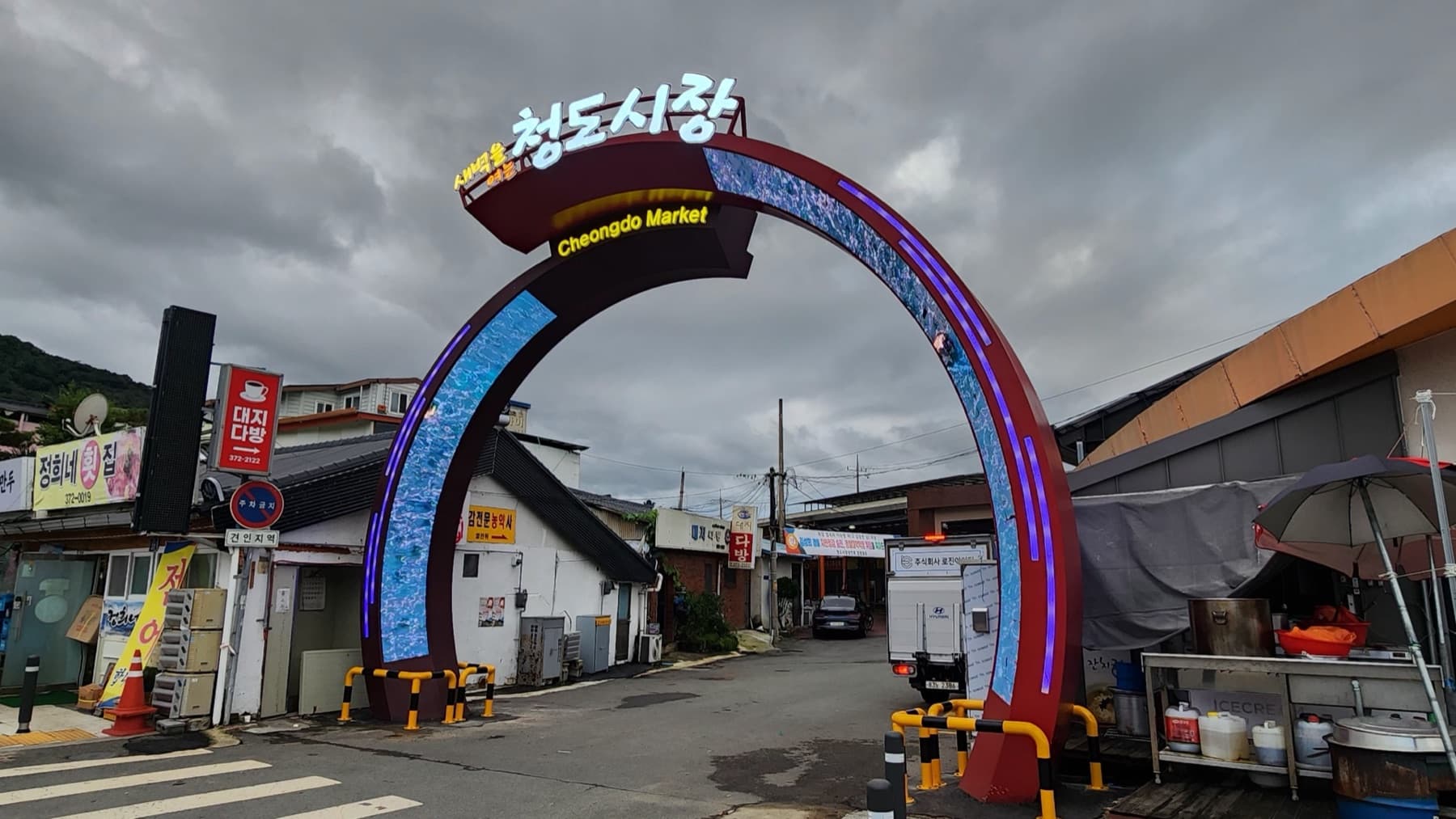
Screens wrapping bridge piers, arches at market entrances, gates framing building entrances. The fastest-growing type of inquiry we get is for these shaped LED displays. They use the same LEDs as flat displays, but the build method, structure and viewing directions are all different. So quotes and installation schedules must be planned differently too.
This article sums up five points we learned installing a bridge pier (Keungogae Intersection), an arch (Cheongdo Market), a gate (Hyangchon Cultural Center), and tunnel, pole and sphere shapes. If you are considering a shaped LED display, check these five points first.
1. Three ways to build a curve
The curve radius decides. Gentle curves use flat cabinets; tight curves use flexible modules.
A curved display is not a single technology. Gentle curves (radius of 3m or more) are built by joining flat cabinets angled 1–5° at each seam. This is the lowest-cost option and uses standard modules, which helps lifespan and maintenance, but the angles are visible up close. For a radius around 1m, the cabinets themselves are made in an arc shape. Columns, arches and spheres with a radius of 0.5m or less use flexible (soft) silicone modules or custom-shaped modules such as trapezoids and triangles.
Flexible modules are 4–6mm thick and attach to cabinets with magnets and screws. They can form convex, concave and even S-shaped surfaces, but cost 30–50% more than standard modules and have a shorter lifespan (per manufacturer data: 5–7 years for flexible vs. 8–10 years for standard). So we use flexible or custom-shaped modules only where the shape must be preserved, and design the rest with flat cabinets to keep costs in line.

2. Never exceed the "minimum bend radius"
Even flexible modules can't bend indefinitely. Check the column diameter first.
Every flexible module model has a minimum bend radius. Standard soft modules go down to about R500mm (a 1m-diameter column). Tighter radii of R200–300mm need special narrow modules. Bending a module past this value cracks the solder joints. It may look fine right after installation, but lines start failing a few months later. The allowed value also varies with concave vs. convex bending and horizontal vs. vertical axis, so the first step is to check the bend direction and radius in the module spec sheet against the site dimensions.
The Cheongdo Market arch is an example. Fitting standard 320×160mm modules straight onto the curve would open gaps between modules and give the edges a stepped look. So we custom-built trapezoidal modules and also made dedicated housings to fit them. Custom-shaped modules require receiving cards that support irregular layouts, so control equipment is selected at the same time.
| Shape | Typical method | What to check |
|---|---|---|
| Gently curved building facade (R 3m or more) | Flat cabinets in angled segments | Angle step (1–5°), seam offsets |
| Column wrap (diameter around 1m) | Flexible modules + curved cabinets | Module minimum bend radius, column roundness |
| Arches, gates, angled forms (with bends) | Custom-shaped modules + custom housings / angled cabinets | Module design for each bend angle, receiving card support |
| Spheres, cubes, polyhedra | Custom-shaped modules + prefabricated frames | Joints between faces, content mapping |
3. The structure is half the job
A shaped display is not a "sign" but a "sculpture." We build it in the factory first.
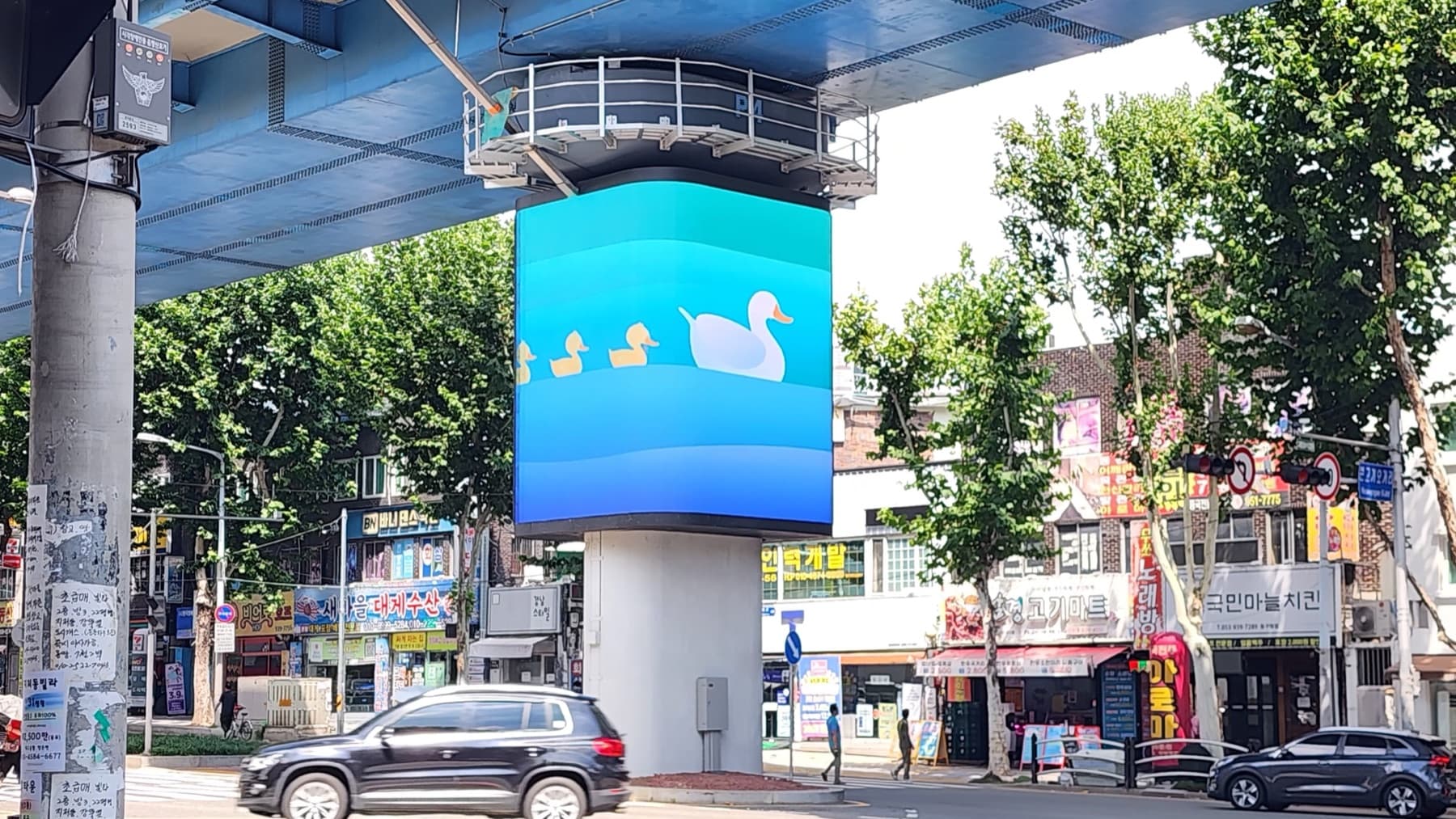
Curved and column displays take more time for structural design than for the screen. At Keungogae Intersection, the bridge piers were not in a straight line but tilted in a diamond pattern, so standard trusses could not be used. We surveyed the position, angle and spacing of each pier, fabricated the trusses in our factory, and erected them at dawn with a 25-ton cargo crane. The 10m-wide structure for the Cheongdo Market arch was split in two because of transport height limits (4.0m, or 4.2m on some roads). It was moved on low-bed trucks, then two cranes pulled it diagonally to join the top section.
That's why we don't build on site. We prefabricate H-beams, trusses and dedicated housings in our factory. This cuts on-site work time, and on busy roadsides we can fix the work window (dawn) and crane staging positions in advance. Outdoor steel is finished with galvanizing or anti-corrosion paint. Large structures develop bending moments under their own weight, so horizontal and vertical reinforcements keep them from warping.

4. For screens seen from many directions, "uniformity" is key
Unlike flat screens viewed head-on, these are seen from the side, below and behind.
LED modules typically have viewing angles of 140° horizontal / 120° vertical, and wide-angle products reach 160°/140°. On a screen wrapped around a column, from any direction some modules are seen head-on and others at an angle, so they look different even at the same brightness. Screens viewed from all sides, like Keungogae Intersection (350°), therefore cannot skip calibration (per-module brightness and color correction). After calibration, we play real video and check the front, sides and nighttime view separately.
After calibration comes the aging test. At Keungogae, we ran the screen 24 hours a day for a month to check for faults in specific module sections. On a shaped display, a single failed module stands out far more than on a flat one. So we plan maintenance access and rear service space at the design stage (Hyangchon Cultural Center has a separate service hatch at the top).
5. Content brings the shape to life
When the screen is curved, the video must be made to fit its shape.
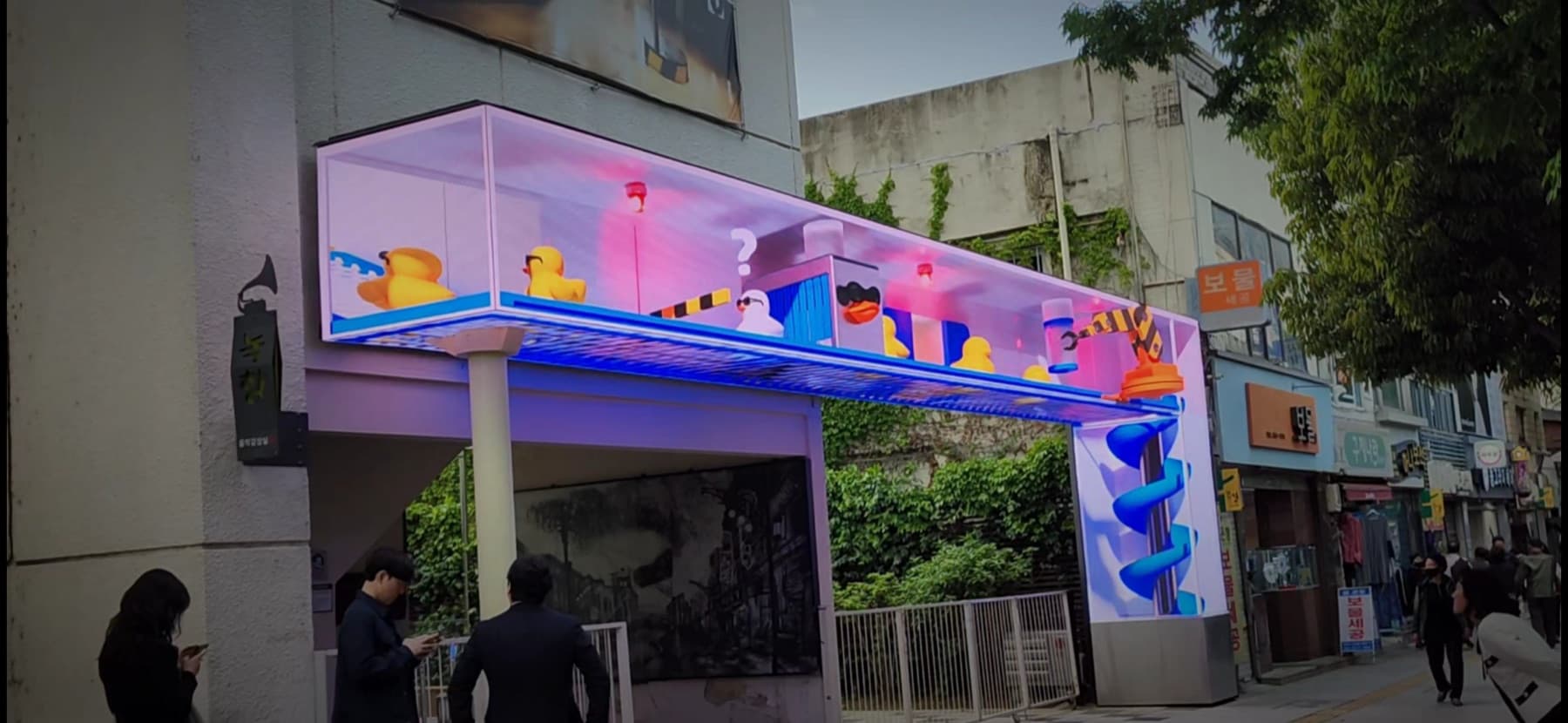
Playing flat-screen video on a curved or column display stretches or crops it. To show content creators where the screen starts, ends and bends, we set reference lines on the cabinets and map the screen area (the screen-edge marker at Keungogae Intersection is one example). Anamorphic and other 3D-effect videos only work from a specific viewpoint. So we first decide where people usually stand and produce content for that position.
In the end, a shaped display is a single package of structure → modules → control → content. That is also why we handle everything from design to content mapping as one team.
① Which method fits which shape
Organized by shapes we have actually installed.
| Desired shape | Suitable method · reference project |
|---|---|
| Screen wrapping a bridge pier or column | Curved cabinets + factory-built trusses · all-around calibration — Keungogae Intersection bridge pier (P8) |
| Arch at a market or park entrance | Custom-shaped (trapezoidal) modules + dedicated housings, structure transported in sections — Cheongdo Market arch (P4) |
| Gate framing a building entrance | Five-sided cabinets + galvanized H-beam frame, top service hatch — Hyangchon Cultural Center gate (P4) |
| Pedestrian tunnel | Continuous curve, minimal gaps between modules — Gumi media tunnel (P2.5, 6m high) |
| Building corners, tight spaces | 30–45° angled cabinets, front maintenance — 45° angled display (P2.5) |
| Sphere and cube sculptures | Custom modules based on curvature calculation, anamorphic video — spherical LED (P2) · cube series (P1.25–P2.5) |
② Pre-installation checklist
For a shaped display, we need the items below to give a quote range.
 Measured dimensions of the structure (column, arch, wall) — diameter or curve radius, height, tilt, column spacing
- Angle the screen will wrap (e.g. 180° · 350°) and where and how far people usually view it from
- Structure condition — concrete or steel, vibration (bridge piers, overpasses), existing foundations
- Transport and lifting conditions — access road width, road height limits, crane position, available work hours
- Power and data entry points and space for the controller
- Content plan — whether 3D video such as anamorphic is planned, who produces it (in-house/outsourced)
- Whether permits are needed, such as outdoor advertising or road occupancy
Curve types and module categories: DOIT Vision, Curved LED Display Types · Unilight, Curved LED Video Wall Design & Installation / Flexible module bend radius, thickness and mounting: Unilight, Flexible LED Display Guide · EagerLED, Flexible LED Display Specs / Custom-shaped modules and receiving cards: Linsn, Creative LED Screen · Colorlight, Creative LED Display / Viewing angle: Unilumin, Understanding Viewing Angles. Installation procedures and site figures (transport height limits, cranes, calibration and aging) come from LO-GIN IT project records (Keungogae Intersection, Cheongdo Market, Hyangchon Cultural Center). Bend radius, lifespan and cost differences are based on manufacturer data and vary by model.
Recommended specs for this guide
- Environment: outdoor · sculptural forms such as columns, arches, gates
- Method: by curve radius — angled segments / curved cabinets / custom-shaped modules
- Structure: factory prefabrication + crane lifting
- Recommended pixel pitch: P4 ~ P8 (based on viewing distance)