
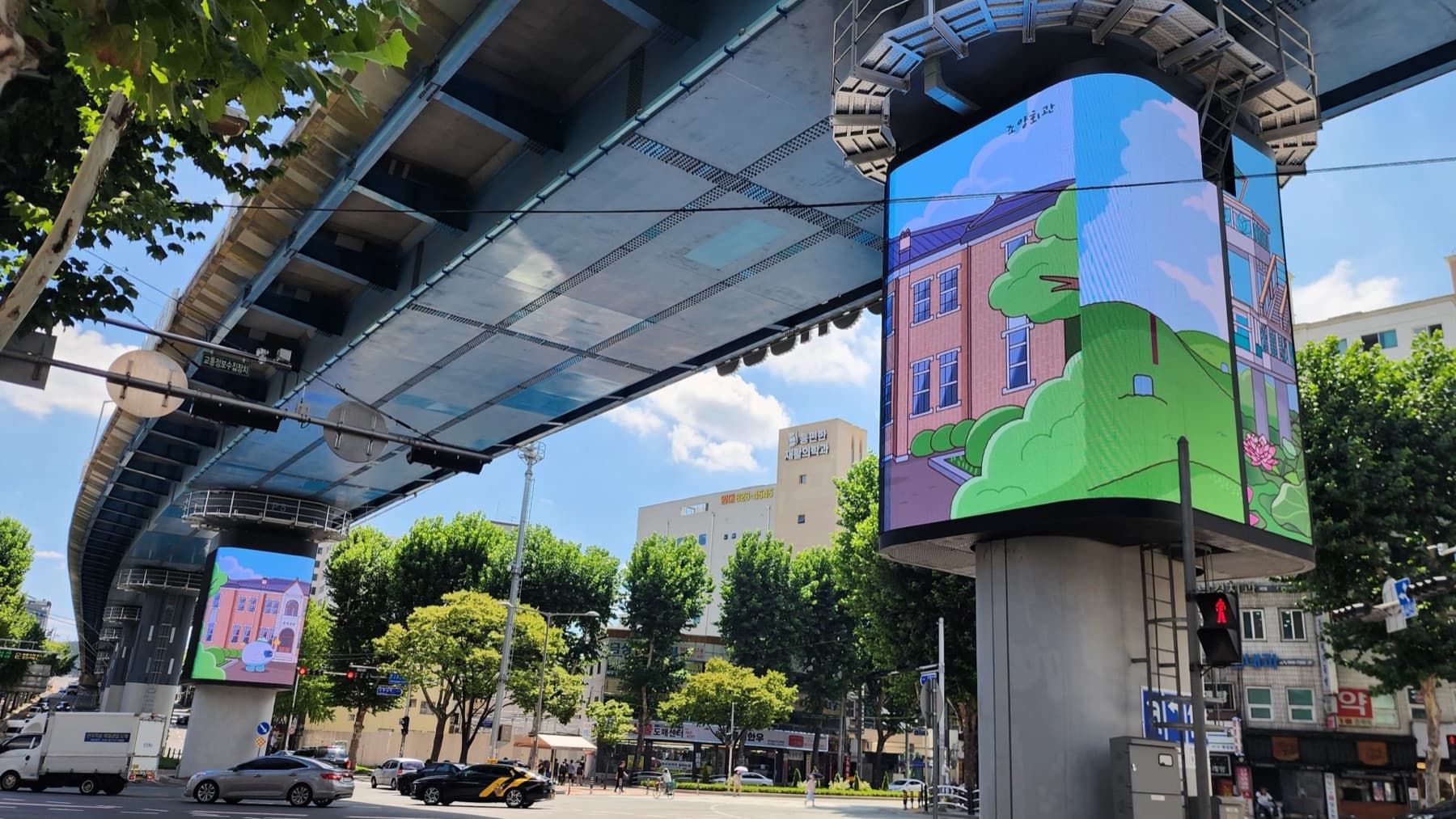
Want to put an LED display on a building exterior or by the road but not sure where to start? For outdoor displays, the installation environment comes before "screen size and price." Even at the same size, specifications and quotes vary widely with brightness, pitch, structure and power conditions.
In this article, we lay out, in order, the five things our installation team checks first during site consultations. By the end, you'll have a clear idea of what to prepare before requesting a quote.
1. Outdoors, brightness is everything
An indoor display mounted outside looks switched off in daylight.
The biggest difference between indoor and outdoor LED modules is brightness. To be visible in direct midday sun, a screen needs 5,000 nit or more, far brighter than indoor modules (800–1,200 nit). In semi-outdoor locations with less direct sun, such as under eaves or inside shop windows, an in-between specification is enough.
Brighter isn't always better, either. Running at full outdoor brightness at night leads to glare complaints. That's why outdoor displays are standardly configured to automatically adjust day and night brightness with a light sensor, and every site we have installed runs this way.

2. Viewing distance determines pixel pitch
Finer isn't always better. For distant viewing, a wider pitch is the right answer.
Pixel pitch determines both image quality and cost. The rule is simple: minimum viewing distance (m) ≈ pitch (mm), and comfortable viewing distance is about twice that. For a display viewed from across the road (10 m or more), P8–P10 is enough and saves cost accordingly. If it is viewed within 3–5 m, such as at a shop entrance, consider P2.5–P4.
That's why the Keungogae Intersection pier display is P8 and the Hyangchon Cultural Center gate is P4. Drivers see the pier from dozens of meters away, while pedestrians walk right beneath the cultural center gate.

| Pitch | Comfortable viewing distance | Typical applications |
|---|---|---|
| P2.5 ~ P3 | 5–6 m or more | Shop entrances · close-range information · walkways |
| P4 | 8 m or more | Low-rise building exteriors · gate-type structures |
| P6 | 12 m or more | Two-lane roadsides · storefronts |
| P8 ~ P10 | 16 m or more | Overpasses and piers · main roads · rooftop displays |
3. It must withstand rain, dust and summer heat
An outdoor display isn't a "brighter indoor display"; it's a different product altogether.
Outdoor modules are sealed at the front to IP65, and cabinets are galvanized and painted to prevent rust. Cabinet joints and cable entry points get additional silicone waterproofing.
What is often overlooked is heat. In direct summer sun, the temperature inside a cabinet rises sharply, so ventilation fans or a rear service passage must be designed in from the start to preserve LED lifespan. When mounting flush against a building wall, leaving a gap at the back for airflow is standard practice.
 IP65 front · IP54 or higher rear, galvanized or powder-coated cabinets
- Silicone waterproofing at joints and cable entry points
- Ventilation fans or rear service space (doubles as maintenance access)
- Lightning and surge protection (SPD) and grounding
4. Decide structure and power before the screen
An LED display is a "heavy sign." First check whether the wall and electrical supply can handle it.
Outdoor cabinets weigh roughly 15–45kg per ㎡ depending on material (die-cast aluminum is light, sheet steel is heavy), plus wind load. Panel walls and older building exteriors can't take the load as is, so a separate structure such as H-beams or a truss, or wall reinforcement, is required. For displays wrapped around pillars or piers, the structure is prefabricated at the factory and erected by crane.
For power, a dedicated circuit and distribution panel is the rule. Outdoor modules draw peak power of up to 400–900W per ㎡ at full white and maximum brightness (the average during actual video playback is about 35–40% of that), so plugging into an existing shop outlet will trip the breaker. Electrical capacity is sized for the maximum, not the average. We also check the route for signal cables (fiber or UTP) to the indoor space where the controller will sit.
5. A quote covers more than the screen
This is why it's hard to answer with a "price per ㎡."
A quote consists of six main parts: screen (modules and cabinets), control and power (controller, receiving cards, power supplies), structure and reinforcement, electrical work, equipment, transport and installation (crane, scaffolding, low-bed vehicles, labor), and content and maintenance. Even for the same 6m × 3m, a ground-floor wall on flat ground is mostly screen cost, while a pier or high-rise exterior shifts the weight toward structure and equipment.
So instead of a "screen price," we first give you a range based on installation conditions, then confirm an itemized quote after the site survey. Sharing the conditions below makes that range much faster to provide.

① The right choice for each situation
Frequently asked questions, organized by situation.
| What you want | The right choice |
|---|---|
| Promotional screen visible to vehicles across the road | P6–P10 · 5,000 nit or more · automatic brightness control |
| Information or menu screen viewed 3–5 m from a shop entrance | P2.5–P4 · one step lower brightness is fine for semi-outdoor |
| Shaped structures such as pillars, curves and gates | Custom cabinets + factory-prefabricated structure · custom-shaped modules |
| Building exterior with a weak wall | Consider wall reinforcement or a freestanding frame (H-beam or truss) |
| Mostly night operation near residential areas | Automatic dimming with a light sensor + operating-hour schedule |
| Concerned about post-installation care | Warranty period + maintenance contract (regular inspection, remote monitoring) |
② Pre-installation checklist
Check these six things and we can wrap up the consultation in one go.
- 2–3 photos of the site (front, side, mounting surface close-up) and desired width and height
- Typical distance (m) and direction of viewers
- Mounting surface material (concrete, panel, glass, steel) and number of floors
- Nearest distribution panel location and spare capacity, and indoor space for the controller
- Main content (images, video, notices) and operating hours
- Whether an outdoor advertising permit is needed (local government and building owner)
Brightness: 4Wall, Outdoor LED Brightness · Litemax, Outdoor Display Brightness Guide / Pitch and viewing distance: Daktronics, Optimal Viewing Distance · Barco, Pixel pitch and viewing distance / IP rating: Example outdoor module specification (IP65 front / IP54 rear) / Power consumption and weight: DOIT Vision, LED Display Power Consumption · NSELED, Power Consumption. Figures vary by manufacturer and model. Installation details are based on LO-GIN IT projects (Keungogae Intersection, Hyangchon Cultural Center, Cheongdo Market).
Recommended specs for this guide
- Environment: outdoor · building exterior
- Recommended brightness: 5,000 nit or more + auto adjustment
- Viewing distance: assumes medium (5–10 m)
- Recommended pixel pitch: P4 – P6