
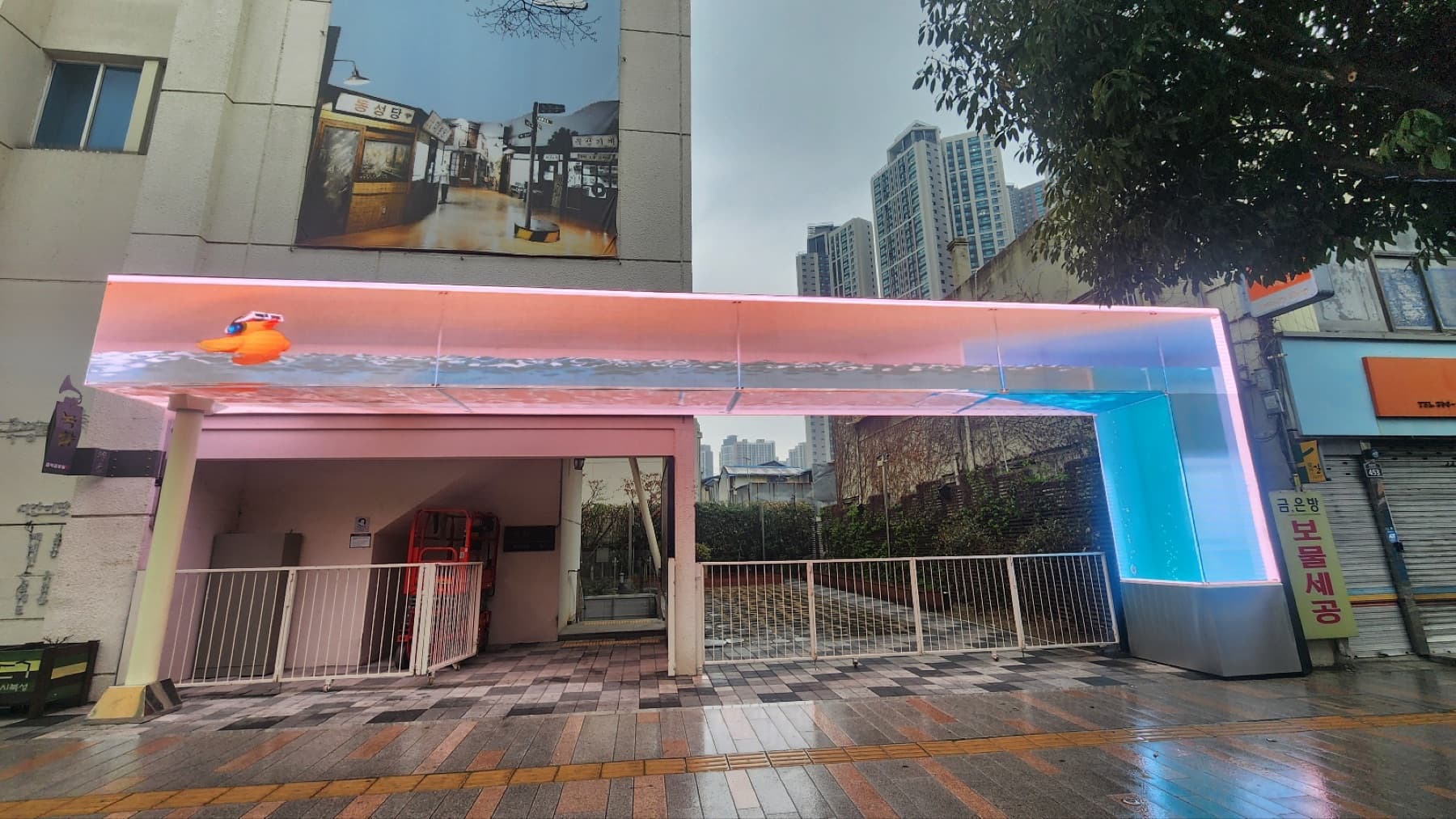
When asked "How much does an LED display cost?", we can't answer right away. We're not hiding anything; the same size can cost more than twice as much depending on the site. On the other hand, if you tell us the seven things below, we can give you a range before the site survey and confirm an itemized quote right after it.
You don't need to prepare everything. Just sending what you have will speed up the consultation considerably.
1. Two or three photos of the site
Front, side and a close-up of the mounting surface — these three are enough.
Phone photos are fine. Front (from where the display will be seen), side (showing the thickness and projection of the wall or pillar), and a close-up of the mounting surface (showing wall material, existing signs and pipes). A night photo also lets us assess ambient lighting and the risk of glare complaints.
Photos alone tell us about half of what we need: whether it can be wall-mounted or needs a structure, and whether a crane can get in. Even the Keungogae Intersection pier project started with roadside photos at the first consultation.
2. Desired width and height
A rough idea is fine. We take exact measurements during the site survey.
LED modules are assembled in 320×160mm units, so the final size is a multiple of that. Give us your desired size and we will match it to the nearest module multiple, which also sets the resolution (horizontal × vertical pixels). It also helps to tell us whether to cover the whole wall, only the sign area, or leave margins.
3. Viewer distance and direction
This determines the pixel pitch, and the pitch drives half the cost.
Just describe it, such as "from cars across the street", "pedestrians 3 m from the shop" or "from the lobby sofa". Minimum viewing distance (m) ≈ pitch (mm), so 10 m or more narrows it to P8–P10 and 3–5 m to P2.5–P4, and that difference is a large part of the screen cost. If it will be seen from several directions, such as on a pillar or corner, let us know. Shaped displays are covered separately in Installation tips for curved and pillar displays.
4. Mounting surface material and floor level
Concrete, panel, glass or steel — the material decides whether structural reinforcement is needed.
Outdoor cabinets weigh 15–45kg per ㎡, plus wind load. On a concrete wall, the frame is anchored directly, but sandwich panels or glass curtain walls need a freestanding frame (H-beam or truss). The installation height (floor level) determines scaffolding and crane costs, and vibrating sites such as piers and overpasses require a different structural design. Building drawings or as-built drawings are ideal, but photos and the floor level are enough to start.
5. Nearest distribution panel and spare capacity
An LED display should have a dedicated circuit. One photo of the distribution panel is enough.
Open the panel cover and take a photo showing the breaker ratings (A) and empty slots. Outdoor displays draw 400–900W per ㎡ at maximum brightness, so an existing outlet won't do; a dedicated circuit is run from the panel, or a new panel is installed. Also tell us the route for power and signal cables (wall penetrations, conduits) and the indoor space for the controller, and we can define the scope of electrical work. Details are in the Dedicated power and distribution panel guide.
6. Content and operating hours
The control setup depends on whether you show images or video and how many hours a day it runs.
For mostly still images and notices, a simple playback setup is enough. For video or real-time information (weather, time, social media), the controller and network setup is more involved. Operating hours (e.g., 07:00–23:00) are used for estimating electricity costs and scheduling brightness (automatic dimming at night). Whether you create the content yourself or have us handle production and mapping is also part of the quote.
7. Desired schedule and permits
Outdoor advertising permits and structure fabrication time set the schedule.
Most outdoor displays require a permit or notification under the Outdoor Advertisements Management Act, and roadside or public sites additionally require a road occupancy permit or consultation with the relevant authority. We will guide you through the process, but checking with the building owner and local government is the client's responsibility, so it helps to look into it early. Sites that need a structure involve factory fabrication time, so if you have a fixed event or opening date, we plan backward from that date.

① What to send in these cases
Organized by common situations.
| Situation | What to send |
|---|---|
| First installation on a building exterior | Front, side and mounting surface photos, desired size, floor level, distribution panel photo |
| Replacing an existing display | Photo of the current screen + size and pitch (we can check from photos if unknown), fault symptoms, whether there is an existing controller |
| Pillars, arches and sculptures | Measured dimensions of the structure (diameter, height, tilt), wrap angle, main viewing position |
| Indoor lobbies and meeting rooms | Wall photo, viewing distance, lighting conditions (near windows or not), existing wiring locations |
| Temporary installation for events and exhibitions | Duration, venue floor plan, delivery route, required size and resolution |
| Public sector orders | Statement of work and specifications (if any), budget range, delivery date |
② How to send
Attach files to the inquiry form, or simply enter your conditions in the Instant Estimate.
 Instant Estimate — enter location, purpose, distance and size to get a range right away
- Contact & Quote — attach photos and drawings; a summary of your conditions is sent automatically
- Phone 053-625-9199 (09:00–18:00) — send photos afterward by text or email
Figures for viewing distance and pitch, brightness, cabinet weight and power consumption share the sources of 5 things to know before installing an outdoor LED display (4Wall, Daktronics, Barco, DOIT Vision, NSELED). The checklist items and consultation process are based on LO-GIN IT's consultation and installation records. Outdoor advertising permit requirements vary by local government, so please check individually.
Recommended specs for this guide
- Prepare: 2–3 photos · desired size · viewing distance
- Power: distribution panel photo · spare capacity
- Content: type · operating hours
- Schedule: desired timing · permits