
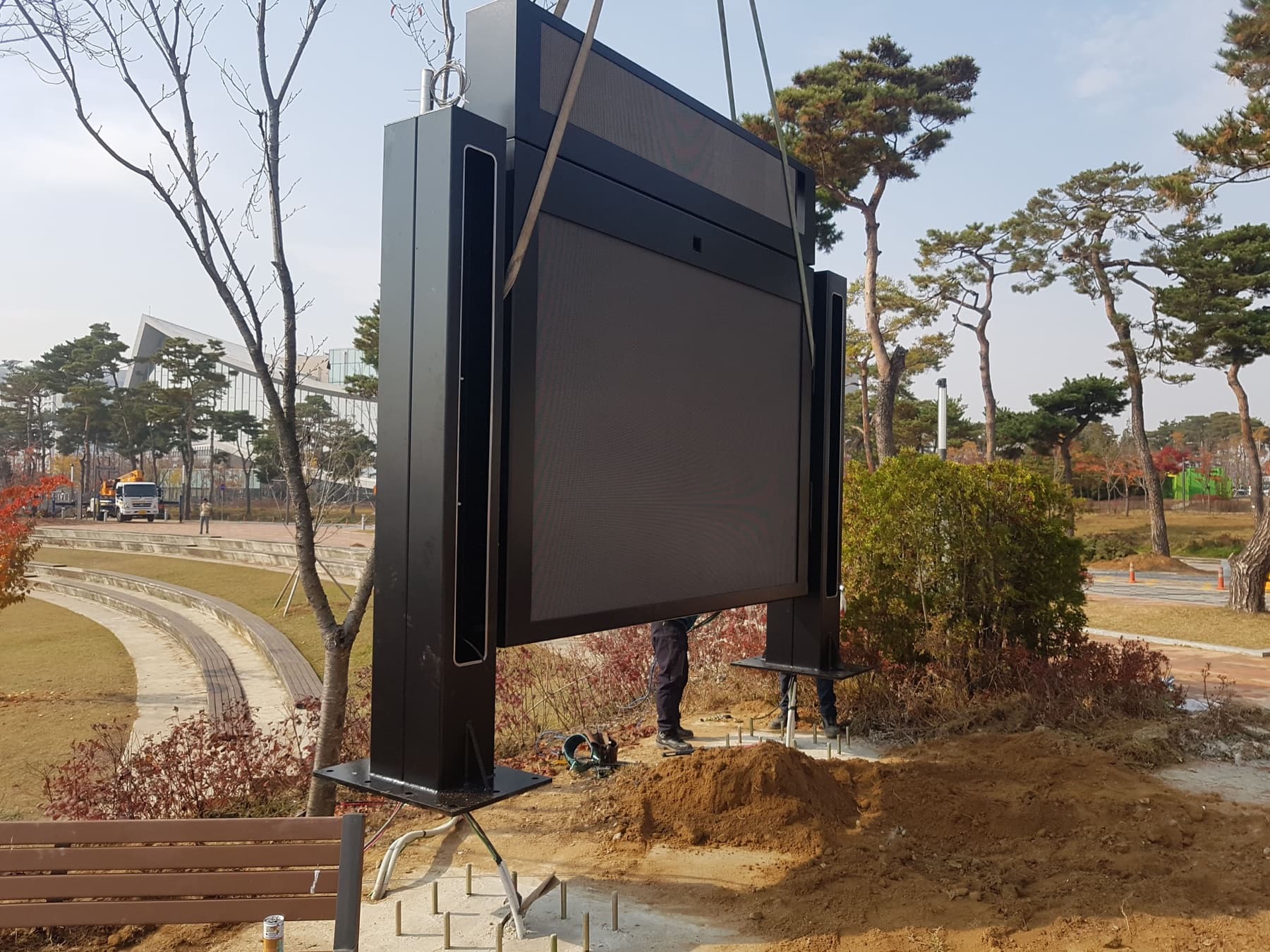
In procurement by local governments and public institutions, the screen you get is exactly what the specifications (spec sheet or task order) say. Leave out an item and a lower-spec product arrives; overstate the numbers and the budget overruns. Based on our public projects such as Sejong Lake Park, Dongdaegu Station and Hyangchon Cultural Center, we summarized the items every specification must include and what they mean.
Use this as a reference when procurement officers review specifications or ask a contractor for a draft.
1. Display specs — these five lines are key
Pitch, brightness, refresh rate, grayscale, viewing angle.
| Item | Meaning | How to specify |
|---|---|---|
| Pixel pitch | Spacing between LEDs (mm). Determines viewing distance | As an upper limit, e.g. "P4 or finer". Distance (m) ≈ pitch (mm) |
| Luminance (brightness) | nit. Outdoor 5,000+, indoor 800+ | "5,000nit or higher, automatic adjustment via light sensor" |
| Refresh rate | Screen refresh in Hz. Important when filmed or broadcast | "3,840Hz or higher" (1,920 acceptable for promotion) |
| Grayscale | Color gradation bit depth | "12-bit or higher" |
| Viewing angle | Horizontal/vertical angle | "140°/120° or wider" (160° for columns and corners) |
| Resolution | Total pixels on screen | Calculate from screen size and pitch and state it |
2. Environmental and structural specs
Outdoors, waterproofing, temperature and structure are part of the spec.
| Item | Example standard |
|---|---|
| Dust and water protection | Outdoor: IP65 or higher front, IP54 or higher rear |
| Operating temperature and humidity | -20~50℃, 10~90% RH |
| Cabinet | Galvanized steel or aluminum, waterproof gaskets, specify front or rear service access |
| Structure | Submit a structural review for wind and dead loads; anchor pull-out test |
| Electrical | Dedicated circuit and distribution panel, grounding, surge protection device (SPD), safety-certified materials |
| Power consumption | State max and average W/㎡ (for sizing electrical capacity) |
3. Control and operation specs
Leave these out and you get a screen that "turns on but can't be operated."
 Controller type (asynchronous) + cloud/remote publishing, scheduling and monitoring
- Receiving card specs (pixel capacity, calibration, irregular layouts) and spare quantity
- Content production scope (number of initial content pieces, mapping data provided)
- Operator training, admin accounts, manual
- Playback logs and proof-of-play reports (for ad campaigns and administrative reporting)
4. Certification, warranty and maintenance
These items decide the three years after delivery.
| Item | Recommended wording |
|---|---|
| Certification | Electrical product safety certification (KC); EMC conformity if required |
| Defect warranty | Period (typically 1–2 years), scope and free-of-charge conditions |
| Maintenance | Number of regular inspections, emergency response time, spare parts quantity (modules, receiving cards, power supplies) |
| Commissioning | Acceptance after calibration + aging test (continuous operating hours) |
| Completion documents | Drawings, structural review, pull-out test, settings backup, mapping data |
| Permits | Scope of preparing and supporting outdoor advertising permit documents |
5. Common mistakes
Problems we often see in specifications.
- Fixing the pitch at a single value like "P2.5" over-specs a large outdoor screen → state an upper limit ("P4 or finer") and the viewing distance
- Specifying brightness but not auto-dimming, leading to nighttime complaints
- No receiving card or controller items, so the cheapest control parts get installed
- Missing spare parts and maintenance terms → one faulty module leaves a color mismatch
- Accepting the screen after only checking that it lights up, with no aging or calibration
① Specification checklist
Review in this order.
- ① Are viewing distance and environment stated, and do pitch and brightness match them?
- ② For outdoor use, are IP, temperature, structural and electrical items included?
- ③ Are control (asynchronous, remote, monitoring) and receiving card specs included?
- ④ Are content, training, mapping and logs within the scope of work?
- ⑤ Are warranty, maintenance, spare parts, commissioning and completion documents included?
Spec item explanations: Ledman, Decode LED Display Specs · Unilight, LED Display Specifications Guide · DOIT Vision, LED Display Parameters · LED Display Factory, How to Read a Spec Sheet / Permit items: Easy-to-Find Korean Law Information (easylaw.go.kr). Recommended wording and common mistakes are based on LO-GIN IT public projects (Sejong Lake Park, Dongdaegu Station, Hyangchon Cultural Center, Keungogae Intersection); actual specifications follow the procuring agency's standards.
Recommended specs for this guide
- Display: pitch limit · brightness · refresh rate · grayscale · viewing angle
- Environment: IP65 · temperature · structural review · dedicated power
- Control: asynchronous + remote + spare receiving cards
- Warranty · maintenance · aging · completion documents