
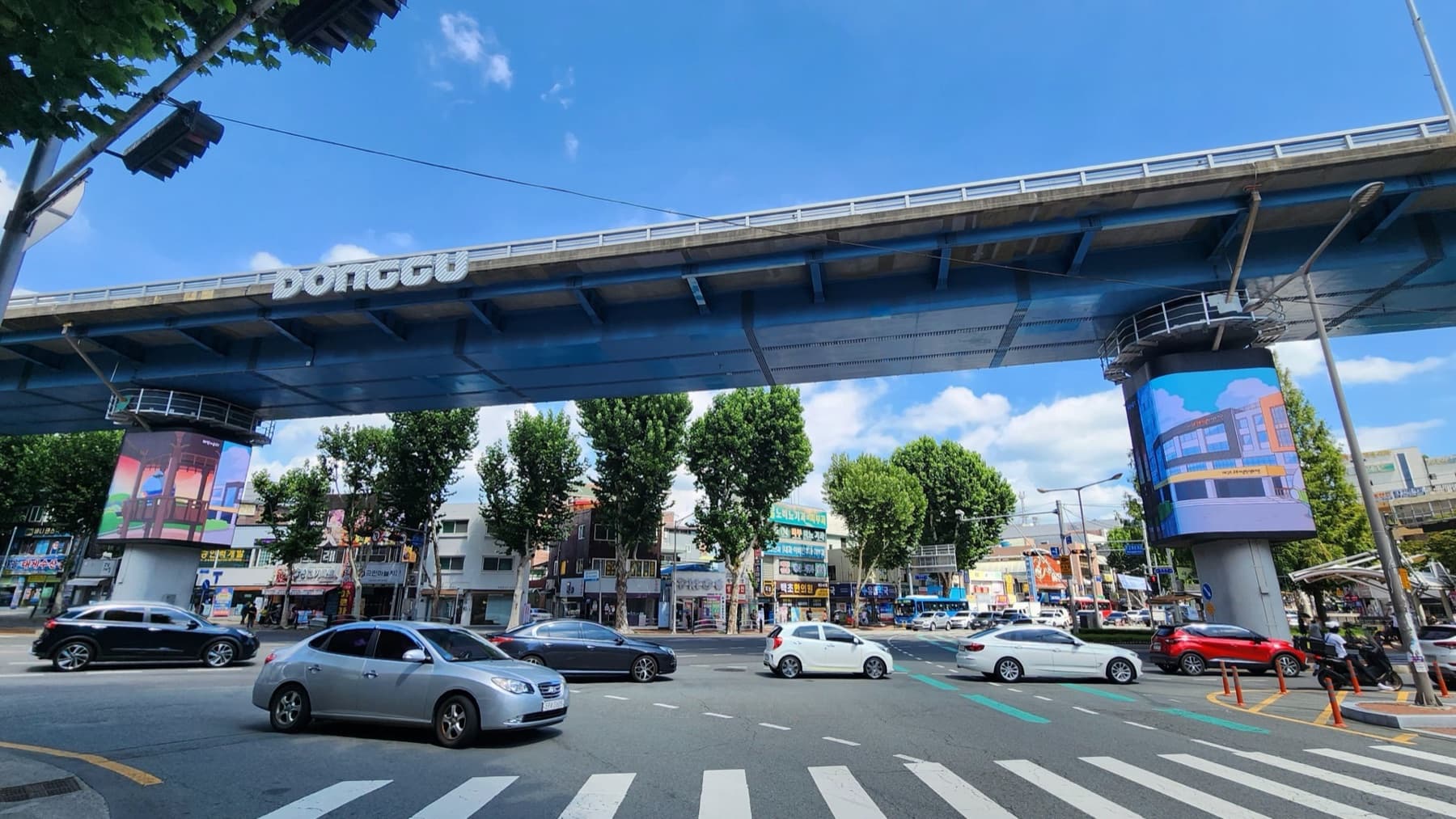
To finalize a quote range, we always visit the site once. Things you can't tell from photos and dimensions alone — what's inside the wall, spare capacity in the distribution board, where a crane can stand, the sun's direction — change the total cost. A survey usually takes about an hour, and we measure and record twelve items.
If you know them in advance, the survey goes faster, and you'll have a baseline for comparing other companies' surveys.
① 1–3. Mounting surface — dimensions, material, load
Three items that decide "where and how" the display is mounted.
① Mounting surface dimensions: We measure not only width and height but also protrusions (eaves, signs, pipes) and tilt. At Keungogae Intersection, the bridge piers tilt in a diamond pattern, so standard trusses couldn't be used and custom ones were built.
② Material: Mounting methods differ for concrete, sandwich panels, glass curtain walls and steel. Panels and glass can't take anchors, so a freestanding frame is needed.
③ Load: We add wind load to the cabinet weight (15–45kg per ㎡) and check whether the wall or structure can bear it. Older buildings and vibrating sites such as bridge piers and overpasses need more structural review items.
② 4–5. Viewing conditions — viewing position and light
Two items that decide the specs (pitch, brightness).
④ Viewing position, distance and angle: We measure the distance from where people actually stand or pass to the screen, and check the viewing angles from the side and below. Pitch follows the rule distance (m) ≈ pitch (mm).
⑤ Direct sunlight and ambient light: We check which direction and at what time the sun hits, and how bright the surrounding lighting is at night. West-facing walls need extra brightness headroom for afternoon sun, and near residential areas we set a night dimming schedule.

③ 6–7. Power and signal
One photo of the distribution board sets the scope of electrical work.
⑥ Power: We check the nearest distribution board's location, breaker ratings, free circuits and distance to the display. Outdoor displays need a dedicated circuit, so if there's no spare capacity, a new distribution board goes into the quote (Dedicated power and distribution boards).
⑦ Signal cable route: We look at the indoor space for the controller and the cable path from there to the display (wall penetrations, conduits, trays). Long exposed outdoor runs add fiber-optic cable and protective conduit.
④ 8–9. Installation conditions — access and lifting, ventilation and drainage
Items that decide the equipment and work hours.
⑧ Access and lifting: We check access road width for material trucks, road height limits (4.0m, or 4.2m on some roads), where a crane or aerial lift can stand, and available work hours (traffic and noise complaints). For the Cheongdo Market arch, the 10m structure had to be split in two and moved on low-bed trucks.
⑨ Ventilation, heat and drainage: We check for airflow gaps behind the cabinets, space for ventilation fans to remove summer heat, and drainage paths so rainwater doesn't pool. A rear service walkway significantly reduces maintenance costs.
⑤ 10–12. Surroundings, permits, operation
Most post-installation problems come from these three.
⑩ Surrounding obstructions: We check whether existing signs, pipes, street trees or power lines block the screen or get in the way of installation, and whether light shines directly into neighboring buildings or windows.
⑪ Permits and regulations: Whether outdoor advertising permits or notifications apply, road occupancy for roadside sites, and owner consent for leased buildings. We guide you through the procedures, but confirming them is the client's responsibility.
⑫ Operating conditions: What content will play (images, video, real-time information), operating hours, and who will create and update content. These determine the control setup, electricity cost estimate and nighttime brightness policy.
⑥ What you get after the survey
We compile the survey results together with the quote.
| Item | Details |
|---|---|
| Survey record | 12-item check + photos (front, side, mounting surface, distribution board, access road) |
| Recommended specs | Pitch, brightness, cabinet configuration, screen size (in module multiples) |
| Structural & electrical review | Need for reinforcement, dedicated circuit and distribution board scope, signal cable route |
| Itemized quote | Screen / control & power / structure / electrical work / equipment, transport & installation / content & maintenance |
| Schedule | Reflects structure fabrication time, work hours and permit lead time |
⑦ Helpful to prepare before the survey
The survey can proceed without them, but with them we can define the scope the same day.
 Building drawings or as-built drawings (to check wall structure)
- Distribution board key and building management cooperation (to check the electrical room)
- Access to the installation location (rooftop, machine room, behind signs)
- Notes on desired size, content and operating hours
- Owner consent if the building is leased
Survey items: Linsn, LED Display Installation Guide · Unilight, Installation & Maintenance Guide · Royal Display, Installation Guide. Weight, power and distance criteria share the sources of our 5 points for outdoor installation and dedicated power articles. Site examples (pier tilt, split transport, work hours) are from LO-GIN IT project records.
Recommended specs for this guide
- 12 survey items + 5 types of photos
- Results: recommended specs · structural/electrical review · itemized quote
- Takes about 1 hour
- To prepare: drawings · distribution board access · desired conditions